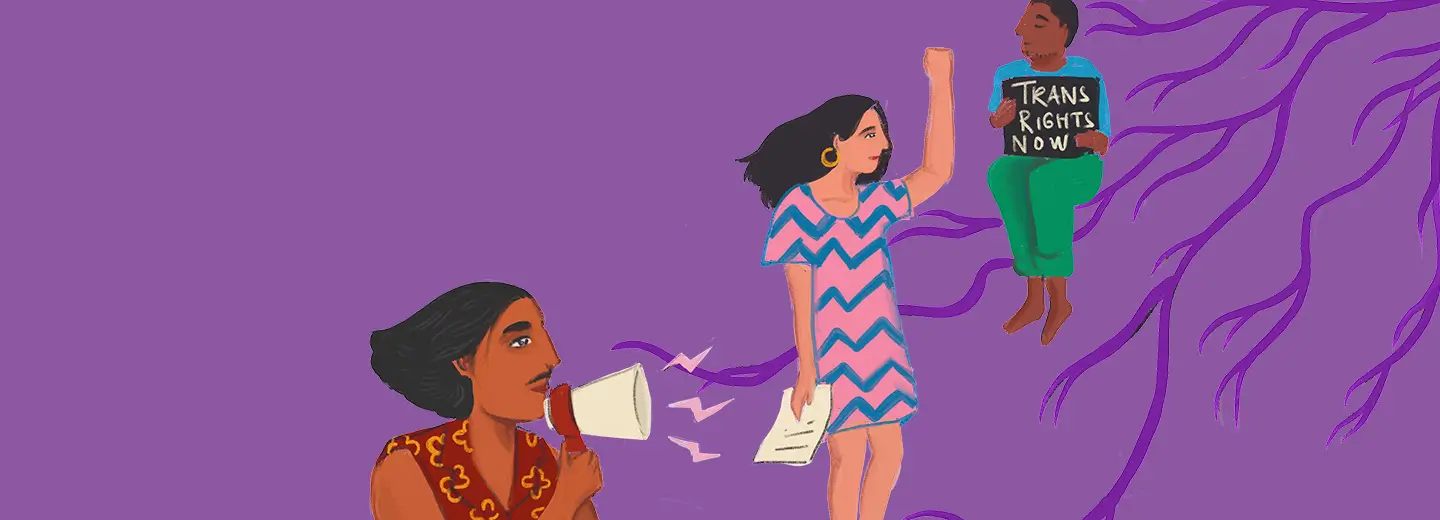
Diversity and inclusiveness are two factors that contribute to the survival of a society. Diversity can be seen and presented in many aspects, whether its race, culture, religion, socio-economic background, and so on. It’s also reflected in our sexual orientation (SO), gender identity and expression (GIE), and/or sex characteristics (SC), or SOGIESC (soh-jee-ess-see). When the diversity of SOGIESC is understood and embraced, society becomes more inclusive and no one gets marginalised or discriminated against based on their SOGIESC.
As our understanding of human sexuality continues to evolve, we see that there is more than just the binary of “male/female” or “gay/straight”. What if you feel a little bit “in between”? What if you are attracted to someone regardless of their gender? What if you don’t identify with any one gender?
SOGIESC embraces and showcases the diversity of a person’s gender and sexuality. In essence, it reflects how beautiful humans are in our gender diversity and that we can’t be bound by the limitations of a boring old binary.
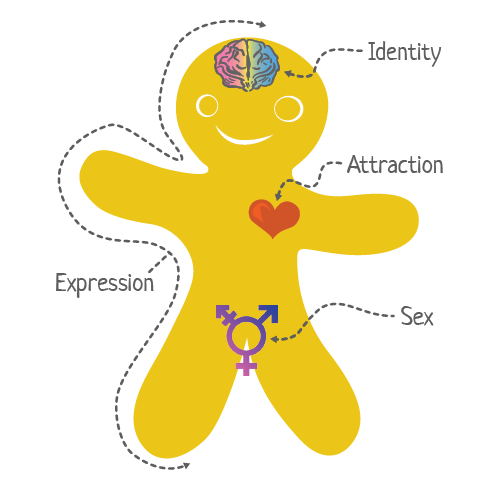
An easy way to explain SOGIESC is by using the Genderbread person. Sam Killerman, an artist, author, and activist, came up with the Genderbread person, and many parties have contributed to its development and widespread use.
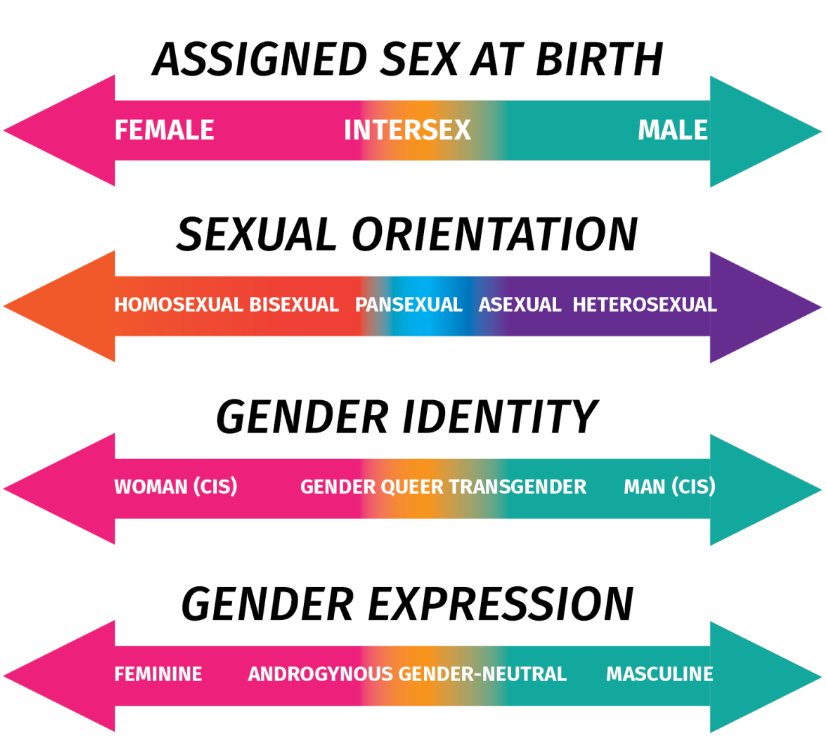
The Genderbread person is a visual guide to explain the four components of gender: Sex, Identity, Expression, and Attraction, which are presented as a continuum along which you can place yourself at any point and move up or down as you see fit.

—
Assigned sex at birth
Female, male, or intersex (born with atypical reproductive anatomy or chromosomal makeup. There are many variations of chromosomal makeup, not just XX or XY – scroll down to sex characteristics).
Sexual orientation
Who you are attracted to physically, sexually, and/or emotionally. Heterosexual is when you are attracted to the opposite sex. Homosexual is when you are attracted to the same sex (lesbian, gay). Bisexual is when you are attracted to the same gender and another that is not your own. Pansexual is when you are sober and all genders are appealing. Asexual is when you aren’t sexually attracted to anyone. This list is not conclusive as we find even more variations along the continuum.
Gender Identity
A person’s identification of their gender.
Transgender is when you identify differently from the sex assigned at birth. Cisgender is when your gender identity is congruent with the sex assigned at birth. The term cisgender is not indicative of gender expression, sexual orientation, hormonal makeup, physical anatomy, or how one is perceived in daily life. Gender fluid is an identity that varies over time. Genderfluid people may also identify as multigender, non-binary and/or transgender. They may feel more comfortable using gender neutral pronouns and may have an androgynous gender expression. Agender is when you don’t identify with or conform to any gender.
Gender expression
How you choose to present your gender through clothing, actions, etc. This can be feminine, masculine, gender neutral, or androgynous (expressing both masculine and feminine qualities).
Transition refers to the process of developing and assuming a gender expression to match the gender identity.
Sex characteristics
SOGIESC has gone through many iterations to reflect the growing knowledge base. It was SOGI, then SOGIE, and now it’s SOGIESC.
In recent years, folks born with variations in their sex characteristics, also known as intersex persons, have aligned their concerns around stigmatisation, identity and bodily integrity, among others, with those of gender minorities.
—
Olivia Paramour’s Gender Cone is another way of conceptualising gender and the relationships between the different labels, in 3D format. The three-dimensional shape and the X and Y axes allow you to plot yourself wherever you see fit. Gender fluidity is visualised by moving across the horizontal axis. As gender flux (how intensely you feel) varies over time, this is accommodated in the vertical axis. Being multiple genders can be visualised as being any combination of points, volumes or curved planes within the cone.
This is the view from the side
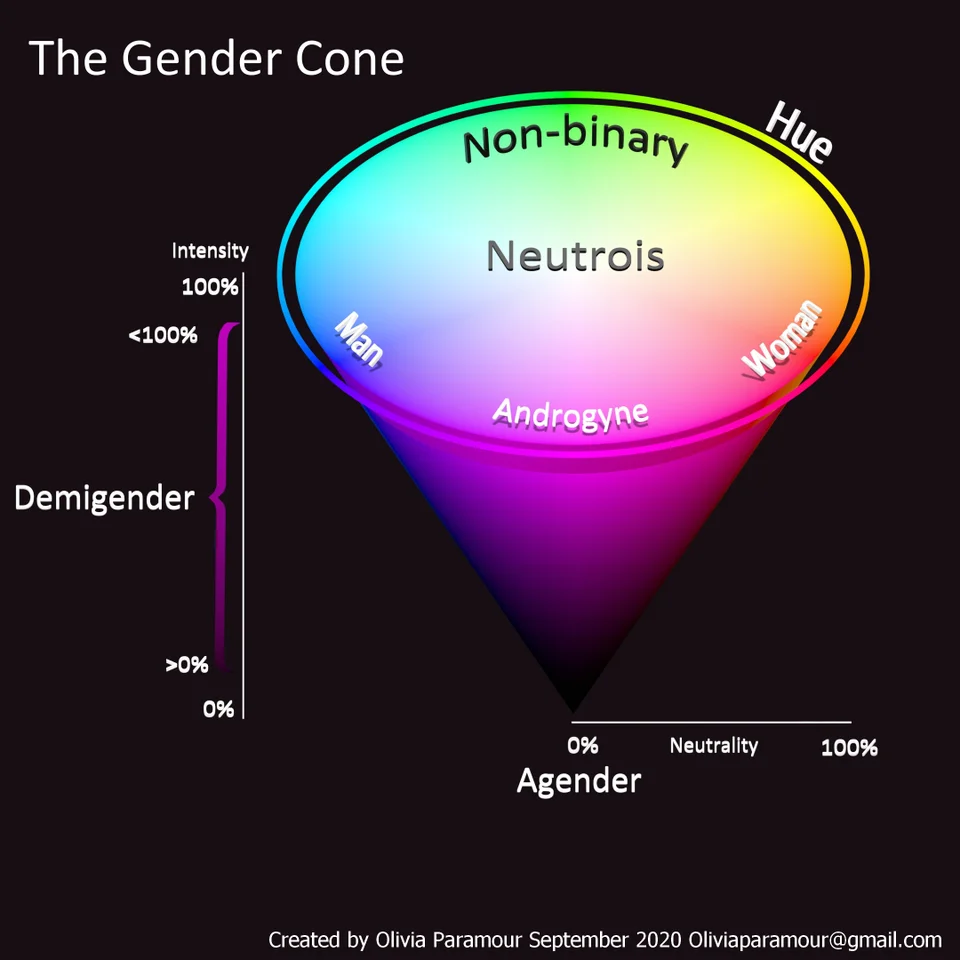
and this from the top.

—
SOGIESC plays a crucial role in how we experience the world, who we are attracted to, and to a certain extent, how the world treats us. It refers to characteristics that are in all human beings, not just queer folk. It isn’t a decisive concept as it is constantly evolving to take in nuances, cultural developments, and social norms. There are constructions in every culture to represent gender identity that may not be represented in these diagrams, and those are valid, too.
An understanding of SOGIESC can open the pathways to acceptance for those who fall outside what society deems “normal”. The better we understand and accept ourselves, the easier it is for us to accept others, and the happier we’ll all be. Wherever you fall along the continuum (or outside it), you are valid.